A Brief Introduction to Quantum Computing for F# Developers
As XKCD stated “All the Fun Parts of Life are Optional”: so is this tutorial.
While understanding qubits, gates, and circuits provides valuable intuition, FSharp.Azure.Quantum prioritizes practical problem-solving over low-level quantum mechanics.
From Classical to Quantum: A Functional Perspective
Classical computation operates on bits—discrete states of 0 or 1. Quantum computation operates on qubits (quantum bits), which exist in superposition states described by complex amplitudes (where “complex” refers math complex numbers). Where classical bits are elements of {0, 1}, qubits inhabit a two-dimensional complex Hilbert space ℂ².
A single qubit state is represented as:
Qubit State Formula:
Where:
- α (alpha) = Complex amplitude for state
|0⟩ - β (beta) = Complex amplitude for state
|1⟩ - Constraint: |α|² + |β|² = 1 (probability conservation)
When measured, the qubit collapses to
|0⟩ with probability |α|² or
|1⟩ with probability |β|².
For F# developers accustomed to algebraic data types and immutability, quantum states are best understood as immutable vectors in a complex vector space. Quantum operations are unitary transformations (reversible linear maps preserving norm), analogous to pure functions that preserve information content.
Type-theoretic view: Consider the classical bit as type Bit = Zero | One. A qubit generalizes this to type Qubit = Complex * Complex with the constraint that amplitudes form a unit vector. But unlike classical sum types where values inhabit exactly one branch, qubits exist in linear combinations of basis states—superposition is fundamentally about linear algebra, not branching logic.
Classical Bit vs Qubit State Space
===================================

Classical Bit:               Qubit State Space (Bloch Sphere):
                                      |0⟩ (North Pole)
  ┌─────┐                              ╱│╲
  │  0  │                            ╱  │  ╲
  └─────┘                          ╱    │    ╲
     OR                          ╱      │      ╲
  ┌─────┐                      ─────────┼─────────  Equator
  │  1  │                      ╲        │        ╱  (superpositions)
  └─────┘                        ╲      │      ╱
                                   ╲    │    ╱
  (Discrete states)                  ╲  │  ╱
                                       ╲│╱
                                     |1⟩ (South Pole)

  Classical: 2 states            Quantum: Infinite superpositions
  Space: {0, 1}                  Space: Unit sphere in ℂ²
Classical vs Quantum:
- Classical: 2 discrete states {0, 1}
- Quantum: Infinite superpositions on unit sphere in ℂ²
Superposition and Entanglement: The Quantum Advantage
Superposition allows a qubit to represent multiple classical states simultaneously. An n-qubit system exists in a superposition of 2ⁿ basis states, enabling massive parallelism. A quantum algorithm manipulates all these amplitudes coherently—conceptually similar to how List.map applies a function to all elements, but with complex interference effects.
Crucially, superposition is not probabilistic uncertainty (as in “the bit is 0 or 1, we just don’t know which”). The qubit genuinely exists in both states, with amplitudes that can interfere constructively or destructively. This interference is the mechanism behind quantum speedups. (To be exact, not only 0 and 1 but also all the numbers in between; the state space is continuous, not discrete.)
Entanglement creates correlations between qubits that have no classical analog. When qubits are entangled, measuring one instantaneously affects the others’ probabilities, regardless of spatial separation.
Bell State Example:
Where:
- |Φ⁺⟩ = Bell state (maximally entangled 2-qubit state)
- |00⟩ = Both qubits in state 0
- |11⟩ = Both qubits in state 1
- 1/√2 = Normalization factor (ensures probabilities sum to 1)
Measuring the first qubit determines the second’s state with certainty—the joint state cannot be factored into independent qubit states.
From a type theory perspective, entanglement means quantum states aren’t simply product types. While classical n-bit states live in {0,1}ⁿ (a product space), n-qubit states live in the tensor product ℂ² ⊗ ℂ² ⊗ … ⊗ ℂ² ≅ ℂ^(2ⁿ), which is exponentially larger. Most states in this space are entangled—separable states form a measure-zero subset.
Why entanglement matters: Entanglement is the resource that powers quantum algorithms. Without it, n qubits would require only O(n) parameters to describe classically. With entanglement, you need O(2ⁿ) parameters—this exponential gap is where quantum computers gain their advantage. Entanglement is also fragile: environmental interaction destroys it (decoherence), making it the primary engineering challenge in quantum computing.

Quantum Gates and Circuits: Composable Transformations
Quantum computation proceeds through quantum gates—unitary operators acting on qubits. The fundamental single-qubit gates include:
- Pauli gates (X, Y, Z): Rotations by π around the respective Bloch sphere axes
Physical origin: The Stern-Gerlach experiment (1922) first demonstrated that spin-½ particles have exactly two measurable states along any axis—the original “qubit” observation.
- Hadamard gate (H): Creates equal superposition
H|0⟩ = (|0⟩ + |1⟩)/√2Where: H = Hadamard gate, transforms |0⟩ to equal superposition of |0⟩ and |1⟩
- Phase gates (S, T): Apply phase shifts without changing measurement probabilities
- Rotation gates (Rx, Ry, Rz): Parameterized rotations by arbitrary angles
Multi-qubit gates create entanglement. The CNOT (Controlled-NOT) gate flips a target qubit conditioned on a control qubit’s state.
With 2 Schrödinger’s cats: If the control cat is dead, flip the target cat’s state. Otherwise, do nothing. When the control cat is in a superposition of alive and dead, the fate of the target cat becomes linked to it — the cats are entangled.
CNOT Truth Table (like classical XOR):
-
CNOT 00⟩ = 00⟩ (control=0, target unchanged) -
CNOT 01⟩ = 01⟩ (control=0, target unchanged) -
CNOT 10⟩ = 11⟩ (control=1, target flipped) -
CNOT 11⟩ = 10⟩ (control=1, target flipped)
Creating Entanglement with CNOT:
CNOT(H ⊗ I)|00⟩ = (|00⟩ + |11⟩)/√2
Where:
- H ⊗ I = Hadamard on first qubit, identity on second
- CNOT = Controlled-NOT gate
- Result = Bell state (maximally entangled)
The Toffoli gate (controlled-controlled-NOT) is universal for reversible classical computation and useful for quantum arithmetic. Together with single-qubit rotations, CNOT is universal for quantum computation—any unitary operation can be approximated arbitrarily well by composing these gates.
Gate universality: In classical computing, NAND gates are universal (any Boolean function can be built from NAND). Quantum universality is similar but richer: any unitary matrix can be decomposed into basic gates. Common universal sets include {CNOT, H, T} or {CNOT, Rx, Ry, Rz}. The choice affects circuit depth and gate count, relevant for NISQ-era hardware with limited coherence times.
These gates compose sequentially and in parallel, forming quantum circuits. The composition model mirrors functional programming: gates are pure transformations, circuits are pipelines, and the entire computation graph is a DAG (directed acyclic graph) of unitary operations.
Bell State Circuit: Creating Entanglement
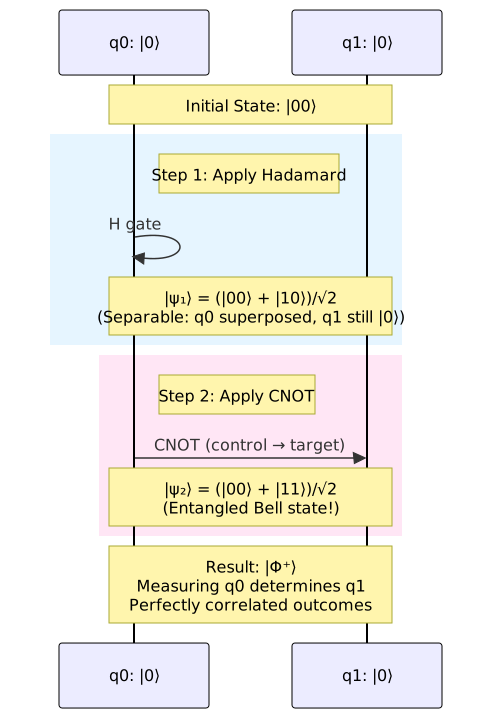
Step 1: Apply Hadamard to q0
Where:
- H = Hadamard gate applied to q0
- ⊗ = Tensor product (combines qubit states)
- Result: q0 in superposition, q1 still
|0⟩(separable state)
Step 2: Apply CNOT with q0 as control, q1 as target
Where:
- CNOT = Controlled-NOT (q0 controls q1)
- Result: Entangled Bell state! Measuring q0 determines q1
Result: Bell state |Φ⁺⟩
- Cannot be factored: Not expressible as
(α|0⟩ + β|1⟩) ⊗ (γ|0⟩ + δ|1⟩) - Measurement outcomes:
- Each qubit gives 0 or 1 with 50% probability
- But outcomes are perfectly correlated: both 0 or both 1

Measurement and Decoherence: The Observer Effect
Measurement is the irreversible process that extracts classical information from quantum states. Unlike classical observation, quantum measurement disturbs the system.
Measurement Formula:
Outcomes:
- Outcome 0 with probability |α|² → state collapses to
|0⟩ - Outcome 1 with probability |β|² → state collapses to
|1⟩
Where:
- α = Complex amplitude for
|0⟩state - β = Complex amplitude for
|1⟩state - |α|² = Probability of measuring 0 (Born rule)
- |β|² = Probability of measuring 1 (Born rule)
The superposition is destroyed—measurement is not a pure function.
This creates a fundamental constraint: you cannot “peek” at intermediate quantum states without destroying the computation. Quantum algorithms must be designed so that measurement at the end amplifies correct answers’ amplitudes while canceling incorrect ones through destructive interference—the hallmark of quantum algorithm design.
The measurement problem: In F# terms, measurement is like forcing evaluation of a lazy value—but with randomness and irreversibility. If Quantum<'T> is your quantum monad, measurement has type signature Quantum<'T> -> 'T, but unlike typical monad unwrapping, it’s probabilistic and destroys quantum information. You cannot clone quantum states (no-cloning theorem), and you cannot “undo” a measurement.
Decoherence is the gradual loss of quantum coherence due to environmental interaction. Real quantum systems are noisy—qubits interact with electromagnetic fields, thermal fluctuations, and other uncontrolled degrees of freedom. Decoherence rates limit algorithm depth and necessitate error correction.
Current quantum hardware operates in the NISQ (Noisy Intermediate-Scale Quantum) era: 100-1000 qubits with limited coherence times (microseconds to milliseconds) and gate fidelities around 99-99.9%. Full quantum error correction requires millions of physical qubits to create thousands of logical qubits—a future milestone.
Quantum Algorithms: Exploiting Interference
Quantum algorithms achieve speedups by exploiting interference—amplifying correct solution amplitudes while canceling incorrect ones. Key paradigms include:
Quantum Fourier Transform (QFT)
The quantum analog of the discrete Fourier transform, computed in O(n²) gates versus O(n·2ⁿ) classically. QFT underlies period-finding algorithms and appears in most quantum speedups.
QFT Transformation Formula:
Where:
- |j⟩ = Input basis state (j = 0 to N-1)
- N = Dimension of the Hilbert space (N = 2ⁿ for n qubits)
- Σk = Sum over index k (all basis states)
- |k⟩ = Output basis states
- e^(2πijk/N) = Phase factor creating interference patterns
The transformation creates interference patterns that encode periodicity information.
Phase Estimation
Given a unitary U and eigenstate |ψ⟩, phase estimation determines the eigenvalue phase φ to n bits of precision.
Eigenvalue Equation:
Where:
- U = Unitary operator (quantum gate/operation)
- |ψ⟩ = Eigenstate of U (input state)
- e^(2πiφ) = Eigenvalue (complex number on unit circle)
- φ = Phase to estimate (real number between 0 and 1)
Phase estimation uses O(n) qubits and O(n²) gates, plus n applications of controlled-U whose cost depends on U. This is the core subroutine for quantum chemistry simulations (estimating molecular energies) and cryptanalysis (Shor’s algorithm). Phase estimation combines controlled-U operations with inverse QFT—a paradigmatic quantum algorithm demonstrating interference-based computation.
Grover’s Algorithm
Searches an unstructured database of N items in O(√N) queries versus O(N) classically—a quadratic speedup.
Grover Operator Formula:
Where:
- G = Grover operator (applied iteratively)
- |ψ⟩ = Uniform superposition
state = (1/√N)Σᵢ|i⟩ - 2|ψ⟩⟨ψ| - I = Inversion about average (reflection operator)
- |target⟩ = Target state we’re searching for
- 2|target⟩⟨target| - I = Oracle that marks the target
Each iteration rotates the state vector toward the target state. After ~π√N/4 iterations, the target amplitude approaches 1, allowing measurement to return the correct answer with high probability. Grover’s algorithm is provably optimal—the BBBV lower bound (Bennett, Bernstein, Brassard, Vazirani 1997) shows any quantum algorithm needs Ω(√N) oracle queries for unstructured search.
F# analogy: Classical linear search is List.find, requiring O(n) comparisons. Grover’s algorithm is like searching with amplitude amplification—but you can’t do better than O(√n) because measurement collapses superposition probabilistically.
Grover’s Algorithm: Amplitude Amplification

Initial State (uniform superposition of N items):
  All amplitudes equal: 1/√N

Amplitude
   ▲
   │     Target
1  │       █
   │     █ █ █
   │   █ █ █ █ █
   │ █ █ █ █ █ █ █
0  ├─────────────────► Iterations
   0   1   2   3   ~√N

After ~π√N/4 Grover iterations:
  - Target amplitude ≈ 1
  - Other amplitudes ≈ 0
  - Measure to get target with high probability

Grover Operator G = -(2|ψ⟩⟨ψ| - I)(2|target⟩⟨target| - I)
                    └─reflection─┘ └──oracle────┘
Visual comparison of search complexities:

Shor’s Algorithm
Factors integers in polynomial time: O((log N)³) versus best classical algorithms requiring sub-exponential time exp(O((log N)^(1/3))). Shor’s algorithm reduces factoring to period-finding in modular exponentiation, solved efficiently via QFT. This threatens RSA cryptography and motivated much quantum computing investment.
Why factoring is hard classically: Given N = pq (product of primes), finding p and q requires testing exponentially many candidates. Shor’s algorithm exploits the periodic structure of modular exponentiation: pick random a, consider the function f(x) = a^x mod N, and find its period r (the smallest r with a^r ≡ 1 mod N). With period r, factor N using gcd(a^(r/2) ± 1, N). QFT finds periods exponentially faster than classical algorithms.
Post-quantum cryptography: Shor’s algorithm breaks RSA and elliptic curve cryptography. NIST is standardizing quantum-resistant algorithms based on lattice problems, hash functions, and multivariate polynomials—problems believed hard even for quantum computers.
Variational Quantum Algorithms
NISQ-era algorithms like VQE (Variational Quantum Eigensolver) and QAOA (Quantum Approximate Optimization Algorithm) interleave short quantum circuits with classical optimization. These hybrid approaches trade exponential speedups for noise resilience—practical for near-term hardware.
| VQE workflow: Prepare a parameterized quantum state | ψ(θ)⟩, measure the expectation value, then use classical optimization to adjust parameters toward the ground state energy. |
VQE Energy Formula:
Where:
- E(θ) = Energy as function of parameters θ
- |ψ(θ)⟩ = Parameterized quantum state (ansatz)
- H = Hamiltonian operator (encodes the problem)
- ⟨ψ|H|ψ⟩ = Expectation value (measured on quantum hardware)
- θ = Classical parameters (optimized with gradient descent, Nelder-Mead, etc.)
VQE finds molecular ground states for quantum chemistry applications.
QAOA: Applies alternating layers of problem-encoding and mixing Hamiltonians, with parameters optimized classically. QAOA solves combinatorial optimization problems (Max-Cut, TSP) approximately. Performance depends on circuit depth (limited by decoherence) and classical optimizer quality.
F# perspective: Variational algorithms are functional pipelines: quantumCircuit >> measure >> classicalOptimize >> repeat. The quantum portion is a parameterized pure function; the classical optimizer manages mutable state. This hybrid model suits F#’s strengths in both domains.

VQE/QAOA Hybrid Loop:

Quantum Computing Models and F# Abstractions
Several formal models capture quantum computation:
Circuit Model: Computation as sequences of gates on fixed-width qubit registers—analogous to imperative programming with mutable arrays, but unitary.
Measurement-Based Quantum Computing: Prepare a large entangled resource state, then compute by measuring qubits in chosen bases. Surprisingly equivalent to the circuit model.
Adiabatic Quantum Computing: Encode problems in Hamiltonian ground states, evolve slowly from simple to complex Hamiltonians. The adiabatic theorem guarantees the system remains in the ground state—used by quantum annealers like D-Wave systems.
Topological Quantum Computing: Use anyons (exotic quasiparticles in 2D systems) whose braiding statistics encode computation. Intrinsically fault-tolerant but technologically distant.
The F# Azure Quantum library adopts the circuit model, exposing quantum operations as computation expressions. The type system ensures safety: Types track quantum values, preventing premature measurement or cloning (forbidden by the no-cloning theorem). This functional approach maps naturally to quantum computing’s reversible, compositional structure.
Building Quantum Intuition: The Bloch Sphere
| Single-qubit states have a geometric representation: the Bloch sphere. The poles represent | 0⟩ (north) and | 1⟩ (south). |
Bloch Sphere: Geometric Representation of Single Qubit
=======================================================

                    |0⟩ (Z-axis, θ=0)
                     ▲
                     │
                     │
              ╱──────┼──────╲
           ╱         │         ╲
        ╱            │            ╲
      ╱              │              ╲
    ╱                │                ╲
   │                 │                 │
   │        θ        │                 │
   │         ◜──────●|ψ⟩               │──── X-axis
   │      ◜          │φ                │     (Hadamard)
   │   ◜             │                 │
    ╲                │                ╱
      ╲              │              ╱
        ╲            │            ╱
           ╲         │         ╱
              ╲──────┼──────╱
                     │
                     ▼
                    |1⟩ (θ=π)
Bloch Sphere Parameterization:
Where:
- θ (theta) = Polar angle (0 to π), determines
|0⟩vs|1⟩balance - φ (phi) = Azimuthal angle (0 to 2π), determines relative phase
- cos(θ/2) = Amplitude for
|0⟩state - e^(iφ)sin(θ/2) = Amplitude for
|1⟩state with phase
Superpositions lie on the surface of the unit sphere.
Quantum gates correspond to rotations:
- X gate: π rotation around x-axis (bit flip)
- Z gate: π rotation around z-axis (phase flip)
- Hadamard: π rotation around (x+z)/√2 axis
- T gate: π/4 rotation around z-axis
This geometric view builds intuition but breaks down for multi-qubit systems—a 2-qubit state requires 6 real parameters (after normalization and global phase), while two Bloch spheres provide only 4. The additional degrees of freedom represent entanglement, which has no classical geometric analog.
Bloch Sphere: Geometric Representation of Single Qubit

Key Points:
| Location | State | Gate from |0⟩ |
|---|---|---|
| North Pole | |0⟩ | I (identity) |
| South Pole | |1⟩ | X (bit flip) |
| +X axis | |+⟩=(|0⟩+|1⟩)/√2 | H |
| -X axis | |-⟩=(|0⟩-|1⟩)/√2 | Z·H |
| +Y axis | |+i⟩=(|0⟩+i|1⟩)/√2 | S·H |
| -Y axis | |-i⟩=(|0⟩-i|1⟩)/√2 | S†·H |
(Operator products act right-to-left: Z·H means “apply H first, then Z”.)
Gates as Rotations:
- X: Rotation by π around X-axis
- Y: Rotation by π around Y-axis
- Z: Rotation by π around Z-axis
- H: Rotation by π around (X+Z)/√2 axis
- Rx(θ): Rotation by θ around X-axis
- Ry(θ): Rotation by θ around Y-axis
- Rz(θ): Rotation by θ around Z-axis
Quantum Error Correction: Fighting Decoherence
Quantum states are fragile. The threshold theorem proves that fault-tolerant quantum computation is possible if physical error rates fall below a threshold (~1% for surface codes). Error correction encodes logical qubits into many physical qubits, detecting and correcting errors through repeated syndrome measurements.
The Shor code encodes 1 logical qubit into 9 physical qubits, protecting against arbitrary single-qubit errors. The surface code arranges qubits in a 2D lattice with local syndrome measurements, achieving high thresholds with realistic hardware constraints. A logical qubit at 10^-12 error rate requires ~1000 physical qubits at 10^-3 error rate.
From a software perspective, error correction is akin to memory management in systems programming—necessary infrastructure that abstracts away hardware imperfections. Future quantum programming will target logical qubits, with error correction handled transparently by compilers and runtime systems.
The scalability challenge: To run Shor’s algorithm on 2048-bit RSA requires ~20 million physical qubits (with surface codes). Current largest machines have ~1000 qubits. Bridging this gap requires advances in qubit coherence times, gate fidelities, and qubit connectivity—the primary hardware challenges over the next decade.
Quantum Error Correction: Logical vs Physical Qubits

Error Correction Code Comparison:
| Code | Physical Qubits | Logical Qubits | Error Rate |
|---|---|---|---|
| Shor Code | 9 | 1 | ~10⁻⁶ |
| Surface Code | ~1000 | 1 | ~10⁻¹² |
Resource Requirements for Shor’s Algorithm (2048-bit RSA):
| Component | Logical Qubits | Physical Qubits |
|---|---|---|
| Main computation | ~6,000 | ~20,000,000 |
| Current hardware (2026) | 0 (NISQ era) | ~1,000 |
| Gap | 20,000× more needed |
(Estimates from Gidney & Ekerå 2019, “How to factor 2048 bit RSA integers in 8 hours using 20 million noisy qubits”.)
Azure Quantum: Practical Quantum Development
Azure Quantum provides a cloud platform for quantum development, offering:
- Multiple quantum backends: IonQ (trapped ions), Quantinuum (trapped ions), Rigetti (superconducting qubits)
- Classical simulators: Full state simulation for development and debugging
- Resource estimation: Predict physical resource requirements for future hardware
- Hybrid algorithms: Seamless integration of quantum and classical computation
The F# Azure Quantum library exposes quantum operations through computation expressions, leveraging F#’s type system for safety and composability. Quantum workflows compile to QIR (Quantum Intermediate Representation), enabling cross-platform execution.

Azure Quantum Development Pipeline:

Backends Available:
| Provider | Qubits | Technology | Connectivity | Best For |
|---|---|---|---|---|
| IonQ | 36 (Forte) | Trapped ions | All-to-all | High-fidelity gates, small circuits |
| Quantinuum | 56 (H2) | Trapped ions | All-to-all | Complex algorithms, high accuracy |
| Rigetti | 84 (Ankaa-3) | Superconducting | Limited (lattice) | Large qubit count, near-term apps |
(Qubit counts as of mid-2026 — check the Azure Quantum provider list for current systems.)
Quantum Computing’s Promise and Limitations
Quantum computers are not universal accelerators—they excel at specific problem classes:
Speedups confirmed:
- Factoring and discrete logarithms (Shor): Exponential speedup, threatens RSA/ECC cryptography
- Database search (Grover): Quadratic speedup for unstructured search, provably optimal
- Quantum simulation: Exponential speedup for simulating quantum systems (chemistry, materials science, many-body physics)
- Linear algebra: Speedups for solving linear systems (HHL algorithm), eigenvalue problems, machine learning kernels—under specific conditions on matrix properties and output requirements
No speedup expected:
- NP-complete problems: Grover provides only quadratic speedup (√N). No evidence quantum computers solve NP-complete problems in polynomial time—most experts believe they don’t.
- Fully random processes: Quantum algorithms require structure to exploit (periodicity, symmetry, interference patterns)
- Most classical algorithms: Quantum advantage requires problem-specific structure. Sorting, graph traversal, string matching—mostly no significant speedup.
The complexity landscape: Quantum computers are believed to define a new complexity class BQP (Bounded-Error Quantum Polynomial-time), sitting between P and PSPACE. The relationships are: P ⊆ BPP ⊆ BQP ⊆ PSPACE. Whether BQP = P or BQP = PSPACE remains open—these are among the deepest questions in complexity theory.
Computational Complexity Landscape

Quantum Speedups by Problem Class:
| Problem Class | Classical Complexity | Quantum Complexity | Speedup |
|---|---|---|---|
| Factoring (Shor) | exp(n^(1/3)) | O(n³) | Exponential |
| Unstructured Search (Grover) | O(N) | O(√N) | Quadratic |
| Quantum Simulation | Exponential | Polynomial | Exponential |
| NP-Complete (SAT) | Exponential | O(√N) via Grover | Quadratic only |
The Church-Turing thesis remains unchallenged—quantum computers solve the same problems as classical computers (both are Turing-complete). What quantum computing does challenge is the extended Church-Turing thesis (that classical computers can efficiently simulate any physical computation): quantum algorithms can solve certain problems exponentially faster.
Quantum supremacy (now often called “quantum advantage”) refers to demonstrating a quantum computer solving a problem infeasible for classical computers. Google’s 2019 experiment computed random circuit sampling in 200 seconds versus an estimated 10,000 years classically. However, the problem had no practical application—demonstrating the challenge of achieving quantum advantage on useful problems with NISQ hardware.
Getting Started with F# and Quantum Computing
The FSharp.Azure.Quantum library provides idiomatic F# abstractions:
open FSharp.Azure.Quantum
open FSharp.Azure.Quantum.CircuitBuilder
open FSharp.Azure.Quantum.Backends

// Low-level circuit construction (functional pipeline)
let bellStateCircuit =
    empty 2                          // Create circuit with 2 qubits
    |> addGate (H 0)                 // Hadamard on qubit 0
    |> addGate (CNOT (0, 1))         // CNOT with control=0, target=1

// Validate circuit
match validate bellStateCircuit with
| result when result.IsValid ->
    printfn "Circuit has %d gates" (gateCount bellStateCircuit)
| result ->
    printfn "Errors: %A" result.Messages

// Execute on local simulator
let backend = LocalBackendFactory.createUnified()
let shots = 1000

// Circuit executes and returns measurement counts
match Primitives.sample backend bellStateCircuit shots with
| Ok counts -> printfn "%A" counts  // e.g. map [("00", 498); ("11", 502)] for the entangled Bell state
| Error err -> printfn "Error: %s" err.Message
This functional pipeline style leverages F#’s composition and type safety. Circuits are immutable values that can be composed, optimized, and validated before execution.
From Theory to Practice: Business-Focused Abstractions
While understanding qubits, gates, and circuits provides valuable intuition, FSharp.Azure.Quantum prioritizes practical problem-solving over low-level quantum mechanics. The library’s design philosophy centers on quantum-empowered business solutions rather than quantum circuit manipulation.
The library’s focus: Enterprise developers and AI agents shouldn’t need Ph.D.-level quantum physics knowledge to use quantum algorithms. Instead, they should express business problems naturally and let the library handle quantum complexity.
Real-world example - compare approaches:
// ❌ Low-level approach (100+ lines of QAOA circuit construction)
// problemHamiltonianGates, mixingHamiltonianGates, graph and params stand for
// the code you would have to write yourself
let circuit =
    empty 12
    |> addGates (List.init 12 (fun i -> H i))  // Initial superposition
    |> addGates (problemHamiltonianGates graph params.[0])  // Problem encoding
    |> addGates (mixingHamiltonianGates params.[1])  // Mixing layer
    // ... repeat for multiple layers
    // ... add measurement
    // ... classical optimization loop
    // ... decode bitstrings to graph coloring
    // ... validate solution
open System.Threading
open FSharp.Azure.Quantum.GraphColoring

// ✅ Business-focused approach (4 nodes × 3 colors = 12 qubits)
let problem = graphColoring {
    node "RegisterA" ["RegisterB"; "RegisterC"]
    node "RegisterB" ["RegisterA"; "RegisterD"]
    node "RegisterC" ["RegisterA"; "RegisterD"]
    node "RegisterD" ["RegisterB"; "RegisterC"]
    colors ["Red"; "Blue"; "Green"]
}

task {
    match! GraphColoring.solveAsync problem 3 None CancellationToken.None with
    | Ok solution ->
        printfn "Register allocation: %A" solution.Assignments
    | Error err ->
        printfn "Failed: %s" err.Message
}
✅ Both approaches use quantum optimization (QAOA), but the business-focused API:
- Expresses domain intent directly (register allocation, not qubits)
- Hides quantum complexity (QAOA, QUBO encoding, parameter optimization)
- Provides validated, actionable results (color assignments, not bitstrings)
- Lets non-quantum-experts use quantum optimization
- Suitable for AI agents reasoning about business logic, not quantum gates
Target users:
- Enterprise developers solving optimization problems (scheduling, routing, allocation)
- Data scientists exploring quantum machine learning and optimization
- AI agents (future): Autonomous systems selecting quantum algorithms for business tasks
- Researchers prototyping quantum algorithms with rapid iteration
The low-level circuit API exists for educational purposes and algorithm research, but production use emphasizes domain-specific builders. As quantum computing matures, we envision AI agents autonomously selecting quantum solutions—they’ll reason about business constraints (minimize cost, maximize throughput), not quantum gates.
The quantum-empowered future: Just as developers use databases without understanding B-trees or leverage GPUs without writing CUDA kernels, quantum computing will become an invisible accelerator for specific problem classes. FSharp.Azure.Quantum bridges today’s quantum algorithms with tomorrow’s automated optimization.
Advanced builders: The library provides specialized computation expressions for common patterns:
// Phase estimation (the T gate has eigenphase 1/8)
open FSharp.Azure.Quantum.Algorithms.QPE  // unitary operators: TGate, PhaseGate, RotationZ, ...
open QuantumPhaseEstimator

// The builder validates the problem and returns a Result,
// so chain the estimation with Result.bind
let phase =
    phaseEstimator {
        unitary TGate
        precision 8
    }
    |> Result.bind estimate

match phase with
| Ok result -> printfn "Phase: %.6f" result.Phase
| Error err -> printfn "Error: %s" err.Message

// Quantum arithmetic operations
open QuantumArithmeticOps

let sum =
    quantumArithmetic {
        operation Add
        operands 5 3
    }
    |> Result.bind execute

match sum with
| Ok result -> printfn "Sum: %d" result.Value
| Error err -> printfn "Error: %s" err.Message

// Tree search (e.g. game AI move selection), shown on a toy game:
// a position is a number, a move adds 1-4, higher numbers are better
open QuantumTreeSearch

// Unlike the two builders above, this one throws on an invalid problem;
// solve returns a Result
let searchProblem = quantumTreeSearch {
    initialState 0
    maxDepth 2
    branchingFactor 4
    evaluateWith (fun (position: int) -> float position)
    generateMovesWith (fun position -> [ for step in 1 .. 4 -> position + step ])
}

match QuantumTreeSearch.solve searchProblem with
| Ok solution -> printfn "Best move: %d (score %.2f)" solution.BestMove solution.Score
| Error err -> printfn "Error: %s" err.Message
These builders (phaseEstimator, quantumArithmetic, quantumTreeSearch, constraintSolver, patternMatcher, periodFinder) provide higher-level abstractions for quantum algorithms, reducing boilerplate and encoding best practices.
Type safety: The library’s functional design ensures:
- Immutable circuits: Circuits are values, not mutable state
- Composability: Circuits combine using standard F# operators (
|>,>>) - Validation before execution: Type-safe gate construction, runtime validation
- Backend abstraction: Same circuit runs on local simulator or cloud hardware
Circuit composition example:
// Define reusable circuit components (circuit as last parameter for piping)
let addSuperposition qubits circuit =
    qubits
    |> List.fold (fun c q -> addGate (H q) c) circuit

let entanglePairs pairs circuit =
    pairs
    |> List.fold (fun c (control, target) -> addGate (CNOT (control, target)) c) circuit

// Compose circuits: GHZ state (|00...0⟩ + |11...1⟩)/√2
let ghzState n =
    empty n
    |> addSuperposition [0]                                   // H on first qubit
    |> entanglePairs (List.init (n-1) (fun i -> (0, i+1)))    // CNOT chain
Practical workflow:
- Develop and debug with local simulators (instant feedback, non-paid qubits)
- Test on Azure Quantum simulators (validate against noise models)
- Execute on real quantum hardware (IonQ, Quantinuum, Rigetti)
- Use resource estimation to plan for future scaled hardware
F# Type Safety in Quantum Computing

Type System Benefits:
| Quantum Property | F# Enforcement | Benefit |
|---|---|---|
| Circuit structure | Immutable Circuit type |
Cannot modify after creation—prevents accidental mutations |
| Qubit indices | Validated at runtime via validate function |
Catches out-of-bounds errors before execution |
| Gate parameters | Strongly typed Gate DU (e.g., RX of int * float) |
Compile-time type safety for angles and qubit indices |
| Backend compatibility | IQuantumBackend interface |
Seamless switching between local/IonQ/Rigetti backends |
Functional Pipeline:
CircuitBuilder.empty    : int → Circuit
CircuitBuilder.addGate  : Gate → Circuit → Circuit
CircuitBuilder.optimize : Circuit → Circuit
CircuitBuilder.validate : Circuit → Validation.ValidationResult
Primitives.sample       : IQuantumBackend → Circuit → int → QuantumResult<Map<string, int>>
The circuit functions are pure, composable, and type-safe; running the circuit on a backend (Primitives.sample) is the only step with side effects—leveraging F#’s strengths for quantum algorithm development.
Further Reading
Foundational Texts:
- Nielsen & Chuang: Quantum Computation and Quantum Information (2010)
The canonical reference—comprehensive, rigorous, ~700 pages covering theory and practice - Mermin: Quantum Computer Science (2007)
Accessible introduction for computer scientists, minimal physics prerequisites - Preskill: Quantum Computation lecture notes
Online course notes from Caltech, rigorous treatment with modern perspective
http://theory.caltech.edu/~preskill/ph229/
Algorithm-Specific Resources:
- Shor’s Algorithm: Original 1994 paper “Polynomial-Time Algorithms for Prime Factorization and Discrete Logarithms on a Quantum Computer”
- Grover’s Algorithm: 1996 paper “A fast quantum mechanical algorithm for database search”
- Quantum Error Correction: Preskill’s notes, Daniel Gottesman’s thesis
Azure Quantum Documentation:
- Platform overview: https://docs.microsoft.com/azure/quantum/
- Q# language reference: https://docs.microsoft.com/azure/quantum/user-guide/
- Quantum Resource Estimation: https://docs.microsoft.com/azure/quantum/intro-to-resource-estimation
Wikipedia Articles (surprisingly good for quantum computing):
- Quantum computing, Quantum algorithm, Quantum gate, Quantum error correction
- Shor’s algorithm, Grover’s algorithm, Quantum Fourier transform
- Qubit, Quantum entanglement, No-cloning theorem
Research Papers:
- arXiv’s quant-ph section for cutting-edge developments: https://arxiv.org/archive/quant-ph
- Key journals: Nature Physics, Physical Review Letters, Quantum
Open-Source Quantum Libraries:
- Qiskit (Python/IBM): Mature ecosystem, extensive tutorials
- Cirq (Python/Google): NISQ-focused, integration with Google’s quantum processors
- Q# (Microsoft): Full-featured quantum language integrated with Azure Quantum
- FSharp.Azure.Quantum (F#): Functional abstractions over Azure Quantum; circuits are submitted in each provider’s native format, no Q# required
Other great F# applications
- This page is featured in F# Advent Calendar 2025: https://sergeytihon.com/2025/11/03/f-advent-calendar-in-english-2025/
Conclusion
Quantum computing represents a paradigm shift—not replacing classical computation but complementing it for specific problem domains. The quantum advantage emerges from:
- Superposition: Representing 2ⁿ states with n qubits
- Interference: Amplifying correct answers through constructive/destructive interference
- Entanglement: Creating exponentially large state spaces with correlations impossible classically
These properties enable exponential speedups for factoring, quantum simulation, and certain linear algebra problems—but not for all computation. Most classical algorithms remain optimal.
The Path Forward: From Theory to Business Value
This introduction covered the foundational science of quantum computing—qubits, gates, entanglement, algorithms, and complexity theory. Understanding these concepts provides valuable intuition for when and why quantum approaches succeed.
However, the future of quantum computing lies in abstraction. Just as modern developers build web applications without understanding TCP/IP packet structures, or train neural networks without deriving backpropagation equations, quantum computing will become a transparent acceleration layer for specific problems.
The FSharp.Azure.Quantum vision:
- Today: Quantum-empowered developers solve real optimization problems (scheduling, routing, portfolio allocation) using high-level domain APIs
- Tomorrow: AI agents autonomously select quantum algorithms based on problem characteristics, without explicit quantum programming
- Future: Quantum advantage becomes ubiquitous infrastructure—automatically invoked when classical methods are insufficient, just as GPUs transparently accelerate graphics or ML workloads
As hardware matures from NISQ devices to error-corrected machines, quantum-classical hybrid systems will tackle previously intractable problems in cryptography, drug discovery, materials science, optimization, and machine learning. The timeline for practical quantum advantage on useful problems remains uncertain—estimates range from 5-20 years for specific applications.
Why F# for quantum computing: The language’s emphasis on immutability, composability, and type safety aligns naturally with quantum computing’s reversible operations, circuit composition, and need for correctness. But more importantly, F#’s support for domain-specific embedded languages (computation expressions, type providers) enables building business-focused quantum APIs that hide quantum complexity.
FSharp.Azure.Quantum brings these abstractions to a practical cloud platform, enabling:
- Immediate value: Solve optimization problems today with local simulation (memory-derived width) or cloud QPUs (100+ qubits)
- Future-proofing: Same code scales from NISQ hardware to error-corrected systems as backends improve
- Accessibility: Enterprise developers use quantum algorithms without quantum physics expertise
- Automation readiness: APIs designed for both human developers and autonomous AI agents
The quantum future is pragmatic: Like GPU computing transformed machine learning and cryptographic accelerators enabled secure communications, quantum computing will become a specialized tool in the computational toolkit—powerful for specific tasks, integrated transparently into hybrid systems. F# developers understanding both functional programming and quantum principles will be well-positioned to build these integration layers. More importantly, F# developers who understand business domains and problem abstraction will drive quantum adoption by making quantum advantage accessible to everyone—from enterprise developers to autonomous AI systems.
Your next steps:
- Install
FSharp.Azure.Quantumand solve a real optimization problem (graph coloring, TSP, portfolio) - Experiment with problem builders—express domain logic, not quantum circuits
- Graduate to algorithm research using circuit-level APIs when curiosity demands
- Build domain-specific quantum abstractions for your industry vertical
- Prepare for the quantum-augmented future—where classical and quantum compute seamlessly interoperate